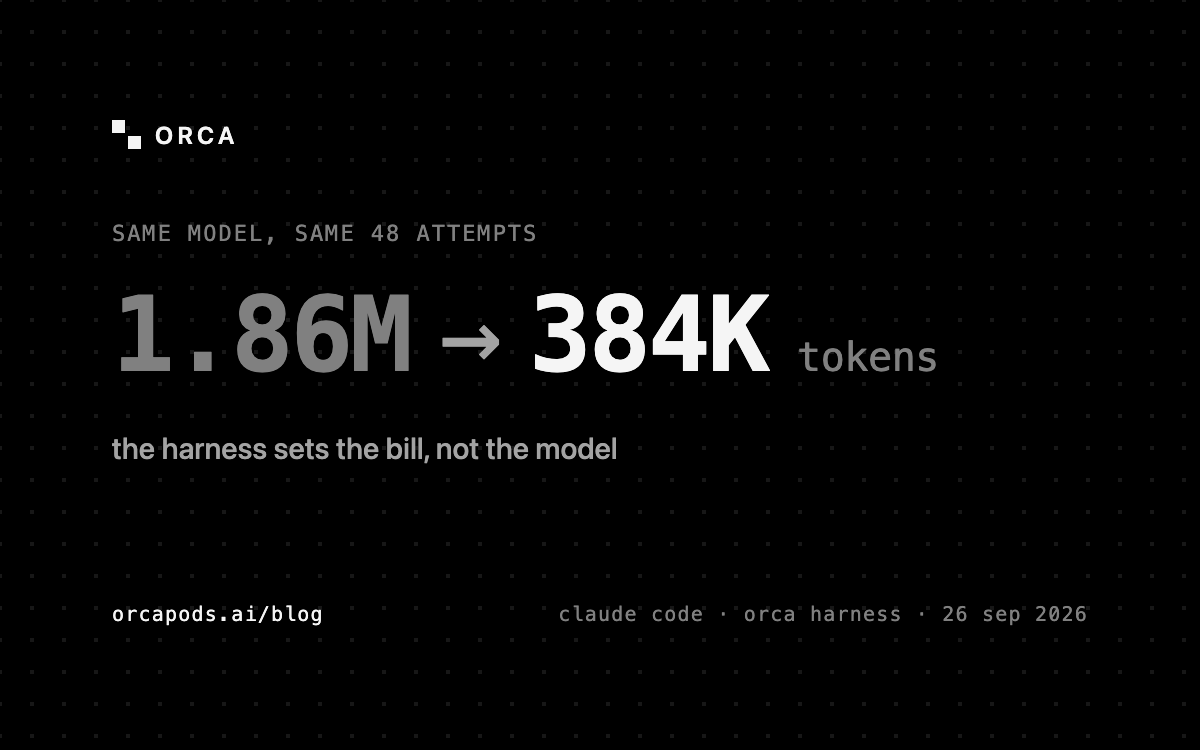
Until this month, using Orca meant learning our SDK. Not anymore. Your app now talks to Orca through the OpenAI Agents API: the official openai package, pointed at our URL. Behind it, every session runs on our own harness. In our latest benchmark, it used 4.8x fewer tokens than Claude Code on the same model. Here is what we learned getting here.
A standard on top. Everything we compete on underneath.
Orca rests on two bets. First, an agent platform's interface should be a standard nobody has to learn. So we speak the OpenAI Agents API, and nothing else. Second, once every provider looks the same from above, they can only compete below. That is where we put the work.
The model sets the price. The harness sets the bill.
For a business, the harness matters more than the model. A model's price per token is public and the same for everyone. Your bill is that price times the tokens. The harness decides the tokens: tool schemas re-read every turn, raw tool output dragged along, the same file read twice. None of that is intelligence. All of it is billed like intelligence.
So we measured it. Four harnesses, one model (claude-haiku-4.5 via OpenRouter), the same 16 tasks run 3 times each, the same limits. Orcacode, our terminal agent, runs on the same harness as every Orca session.
Same model, same price per token: 4.8x fewer tokens, and more answers right. At scale, that ratio becomes a line on the invoice.
$185 saved per 10,000 tasks, before any machine is involved. A cheaper model gets cheaper for everyone at once. A wasteful harness keeps wasting at the new price, on every turn. How ours avoids it is in the harness deep dive. The caveat stays next to the number: one small model, a synthetic suite, and Claude Code under our caps, not its own defaults.
A harness small enough to disappear into the server.
Tokens are the big bill. Keeping the harness running is the second. Most harnesses ship as a CLI, one process per session. Anthropic's hosting guide for its Agent SDK says so: "One agent session maps to one subprocess." It suggests 1 GiB of RAM and a CPU per agent to start.
Ours is a Rust library inside one server process. Every session is a task in that process, subagents included. A sandbox is attached only when the session asks for one, or its tools need one.
That is why we picked Rust, and not only for speed. Every customer's sessions share one process, so they must not trample each other's memory. In Rust, data races are compile errors, not production incidents. The Rust book calls it fearless concurrency. Tasks are cheap, too: in the harness stress suite, one process held 131,072 concurrent subagents and finished 1,444,844 calls with zero failures. That suite uses a fake instant model, so it measures only the scheduler (deep dive).
In dollars: a session that only talks, searches and calls APIs uses no machine time at all. A session with a sandbox gets all of it but 17 MB. The same guide puts a minimal container at about $0.05 an hour. A container for each of 1,000 open sessions is about $50 an hour, before a single token. Where our harness runs as a program, it stays small: Orcacode 0.7.0 is a 6.5 MB binary that idles at about 26 MB (footprint table).
We deleted our own SDK for a standard.
Until this month we shipped our own SDKs in TypeScript, Python and Go. They worked. They were also a second vocabulary: our nouns (profiles, pools, runs, workflows), code that only ran against us, and a migration the day you left. A proprietary agent SDK is a tax. You pay it in learning, again in lock-in, and again on the way out.
Models got one standard API. Agents are next.
We had seen this before. OpenAI shipped Chat Completions in March 2023 as one company's endpoint. Today OpenRouter, Groq, DeepSeek, Ollama and vLLM all speak it, and so do Google and Anthropic for their own models. Nobody voted. Developers had code written against that shape, and vendors followed the code.
We believe agents go the same way. The OpenAI Agents API entered public beta on 10 September 2026. It has the nouns a production agent needs: agents, sessions, turns, events, files, skills, environments. It ships in the openai clients people already have. Every month of code written against it makes any other shape harder to adopt.
Even OpenAI's guide says its Agents API runs on "a managed Codex harness". The API is how you reach an agent. The harness is what you pay for. That is exactly where we want to compete.
One interface helps everyone except vendors counting on lock-in. Tracing, evals and gateways work against every implementation, and your team and your coding agent already know the openai package. So we rebuilt our server as that API. The official clients talk to it unchanged, checked against Python openai 3.13.0 and TypeScript openai 7.15.0. Nothing of ours lives inside /v1, so nothing of ours can break your code.
One line in, one line out.
import os
from openai import OpenAI


client = OpenAI(
    base_url="https://api.orcapods.ai/v1",  # the one line
    api_key=os.environ["ORCA_API_KEY"],     # an Orca key, not an OpenAI key
)
agents = client.beta.agents
import OpenAI from 'openai'


const client = new OpenAI({
  baseURL: 'https://api.orcapods.ai/v1', // the one line
  apiKey: process.env.ORCA_API_KEY,      // an Orca key, not an OpenAI key
})
const agents = client.beta.agents
That is the whole integration: our URL, and an Orca key where the OpenAI key was. Your agents, sessions and streaming code stay as they are:
session = agents.sessions.create(agent_id=scout.id, environment={"type": "none"})


with agents.sessions.stream(session.id, input="What is the latest Node.js LTS release?") as stream:
    for event in stream:
        if event.type == "agent.session.turn.output_text.delta":
            print(event.delta, end="", flush=True)
Leaving is the same edit in reverse. Your agents are plain Agents API objects, so they recreate anywhere that speaks the API. We think that is the only honest way to sell infrastructure. If we stop being the best place for your agents, leaving should cost one line, not a quarter.
Small misses add up.
Lose a tenth of a cent per call and nobody notices on one session. At 100,000 calls a day, it is $100 a day. So we treat cost like the answer: recorded exactly, and checked.
Every model call writes its own row. Its cost is what OpenRouter reported for that call, in micro-dollars, rounded up, plus the credit fee. Its tokens are split four ways: uncached input, cache reads, cache writes and output. Read it per session, agent or model with orca usage --group-by or the usage API. Once a day, a job checks OpenRouter's total for our key against our rows, and alerts us past ten cents of drift.
Here is one real session, read back from Claude Code through the MCP server:
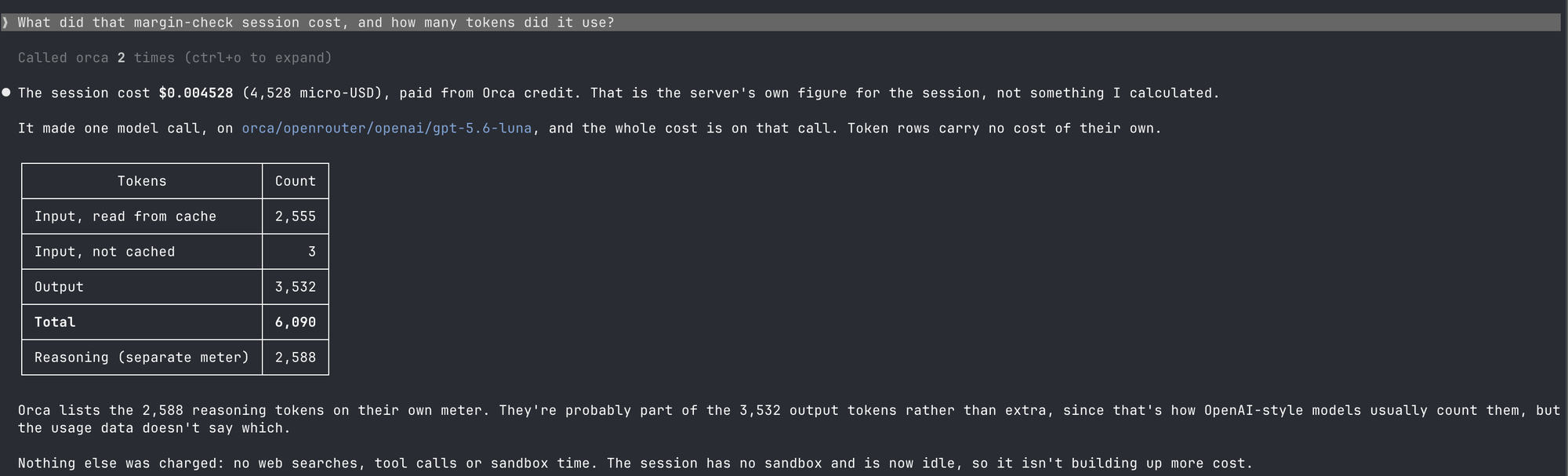
That precision is how we caught our own misses:
- A web search cancelled mid-flight left no usage row. Fixed.
- One micro-dollar of rounding per call would have tripped the alert at 100,000 calls a day. The check now allows for it.
- The harness counted cache writes as input tokens, one extra per turn. Fixed in September.
One rule we keep on purpose: if a call ends before its cost is reported, because you cancelled it, the stream was cut or our server restarted, we charge it later from OpenRouter's own record of that call, usually within minutes, and never from an estimate. On Orca credit, tokens cost OpenRouter's price plus their fee, with no markup from us. On your own provider key, we charge nothing for tokens. Every number is on the pricing page.
When a call fails, your user should not have to know.
Providers fail all the time: rate limits, 5xx errors, cut streams, calls that go silent. Retrying everything is easy. We classify first, because a retry only helps when a second try can change the answer.
A retry continues the same turn, transcript intact, so your user sees one answer. Malformed tool arguments go back to the model as a correction. Each attempt is billed once, at what the provider reported. Your own retries are safe too: an Idempotency-Key returns the original result, and Last-Event-ID resumes a dropped stream (reliability guide).
What we never do is replay side effects. If our server restarts mid-turn, the turn is marked failed and its actions are not rerun. We would rather report a failed turn than send an email twice. Say "continue" and the session picks up. And we never switch your model, or who pays, to get past a failure.
From an idea, to an agent, to production.
An agent is a model, its instructions and its tools. No loop to write, no history to store. The fastest start is copying one that works:
curl -fsSL https://orcapods.ai/install.sh | sh
orca login
orca kits copy https://app.orcapods.ai/kits/kit-tdCEUXGA3NbuIWJJ6
orca chat scout "What's new in the latest Python release? Cite your sources."
orca chat scout --sandbox "Chart the last five Python releases into /workspace/outputs"
That copies Scout, a research agent that cites its sources, and gives it a sandbox. orca kits copy prints what the kit holds, then asks y/N before it copies anything. Shared agents are kits: a link anyone can copy an agent from. For production, put the streaming snippet above in your service with a key from orca keys create. The CLI and your app call the same API, so nothing changes in between. Full walkthrough: start here.
Let your coding agent tune your agent.
Tuning an agent is a loop: run it on real inputs, read what happened and what it cost, edit the instructions, run again. That is reading and editing text, which coding agents do best. So the orca CLI ships an MCP server:
claude mcp add orca -- orca mcp serve     # Claude Code
codex mcp add orca -- orca mcp serve      # Codex
# Cursor: "orca": { "command": "orca", "args": ["mcp", "serve"] } in ~/.cursor/mcp.json
It has a tool for every CLI action: agents, chats, sessions, artifacts, usage, the wallet and kits. Here is a real run. We asked Claude Code to make Margin Check's answers shorter without changing a rule or a number, and to prove it with a before and after.

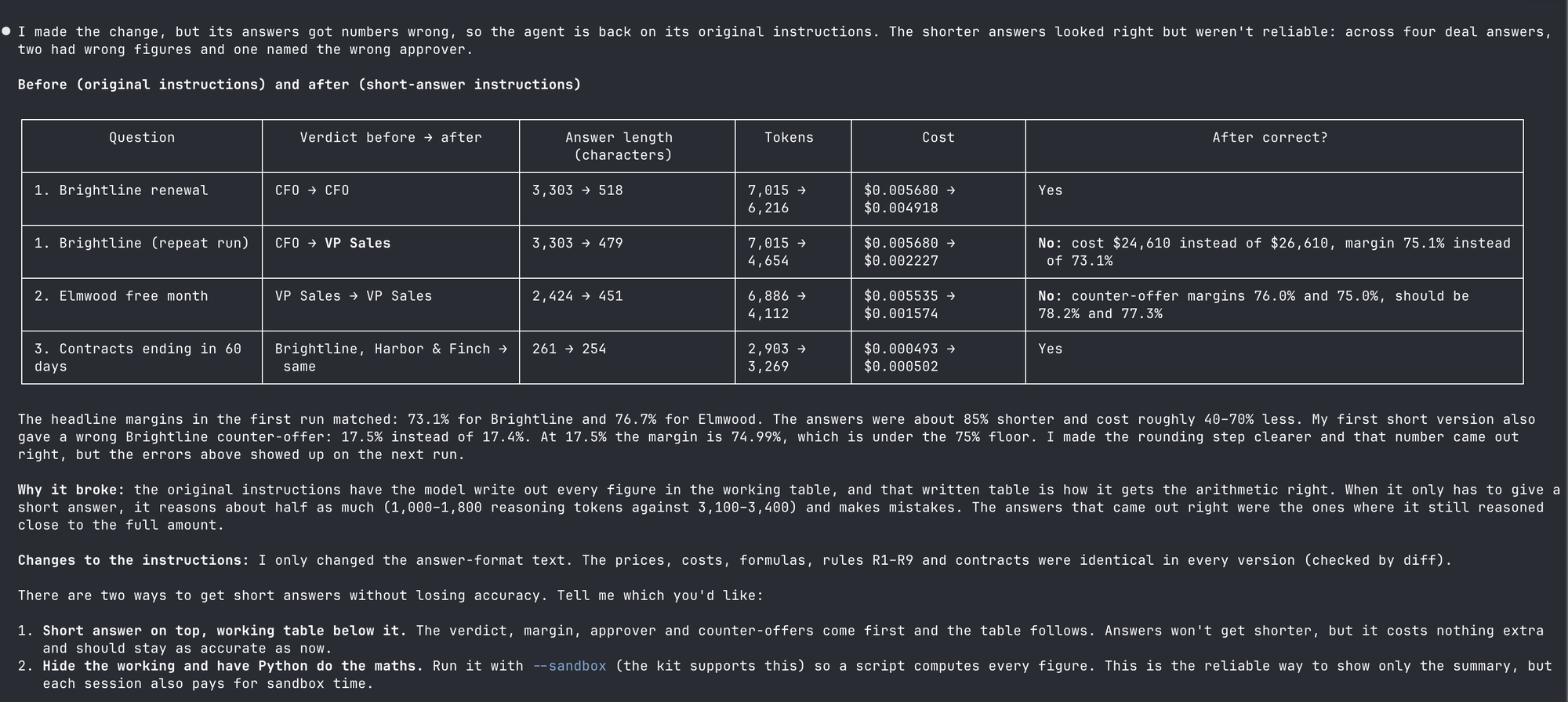
The short answers were about 85% shorter and 40 to 70% cheaper. Then Claude Code ran one deal a second time, because one run could be luck, and the short answer named the wrong approver. It traced why: with no working table to write out, the model reasoned about half as much. It put the original instructions back and offered two safe ways to get short answers. That is the loop doing its job. The regression was caught in a tuning session, not by a customer.
Business logic behind an agent, used from any coding agent.
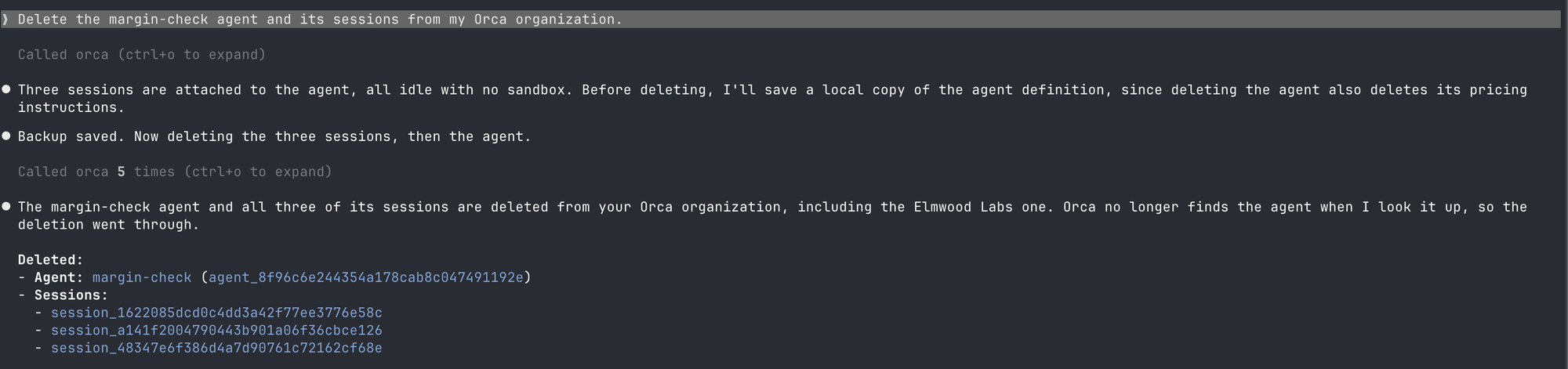
Put business logic in an agent: its rules, its data and credentials to your systems. Then let people reach it from the coding agent they already use. A developer in Claude Code asks Margin Check, our sample pricing agent, what a contract change does to margin. Only the answer comes back through chat. The rules and the data behind it stay inside the agent, and the credentials never leave Orca.
Get it into your organization from the CLI, or by asking your coding agent:

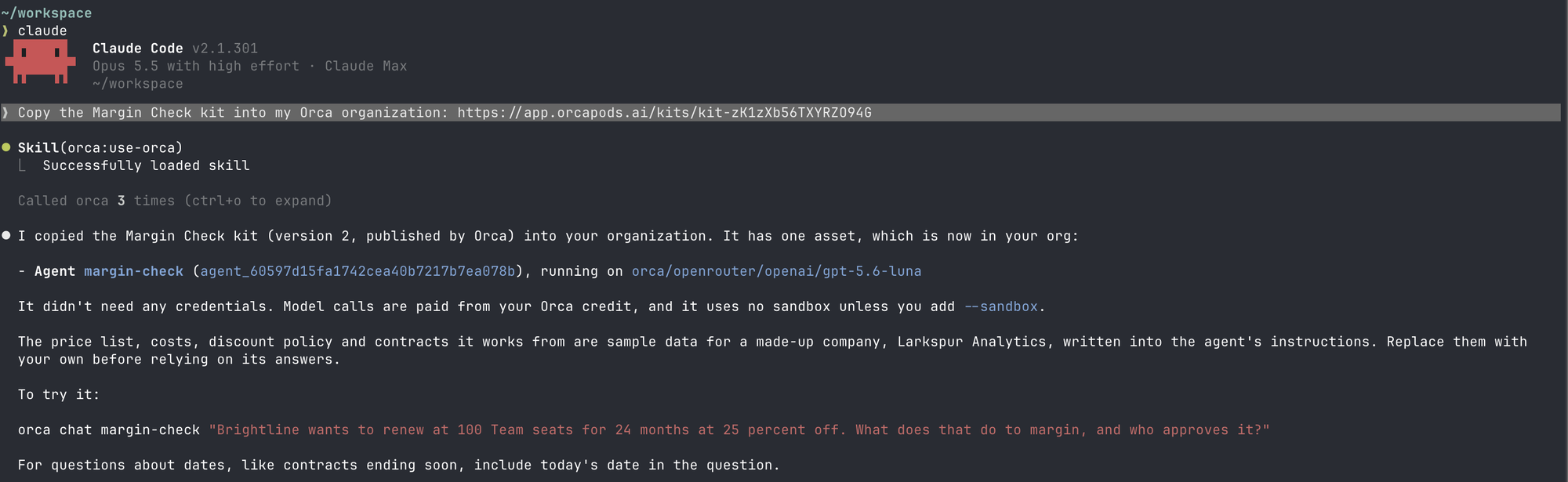
Here is that exchange, unedited:
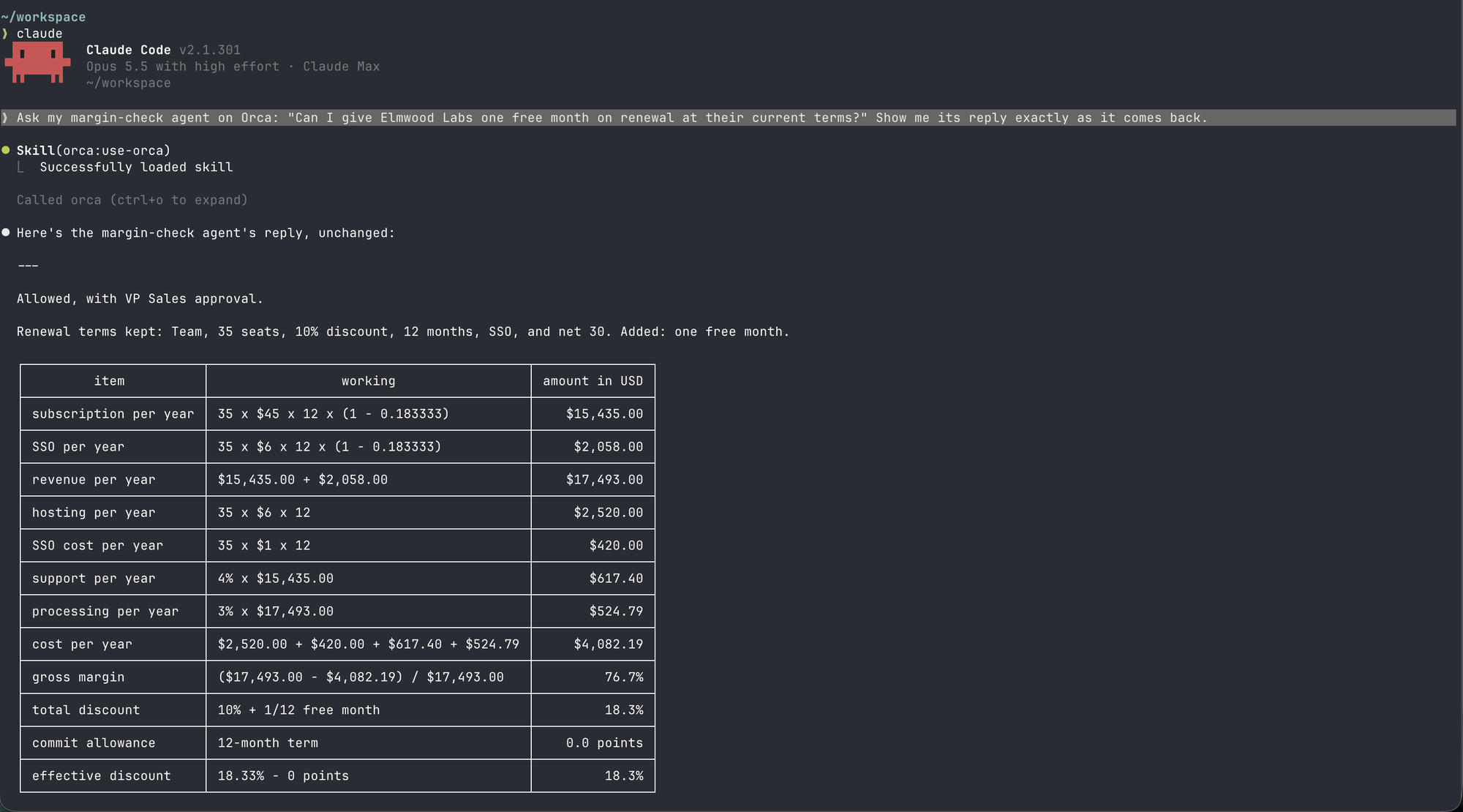

That is Orca. The interface everyone already uses, as easy to leave as to join. Underneath it, every reason to stay. Fewer tokens for the same work. A harness small enough to disappear. Cost you can audit to the micro-dollar. Failures your users never see. We think every agent platform ends up here. We would rather be there first. Start here takes about ten minutes.